Local Conditions
What Knoxville Air Does to a Rug’s Foundation
Damp is a shoulder-season problem in Knoxville rather than a summer one. 138 days a year sit at or above 75% relative humidity and 91 of those reach 80%, but they are bunched into spring and fall, with 31 days over ninety degrees in between and 54 freezing nights at the far end. Rugs here are damaged by the transitions more than by either extreme.
138
Days a year at or above 75% relative humidity
19
Longest unbroken damp run, in days
54
Nights a year at or below freezing
46.1
Inches of rain a year
The swing is the problem
Knoxville does both ends of the year properly: 138 days at or above 75% relative humidity, 31 days over ninety degrees, and then 54 nights at freezing with 6 of them below twenty.
Air that reaches 95% on 46.4% of days keeps the foundation loaded through the warm half, and a heated house pulls it back out through the cold half.
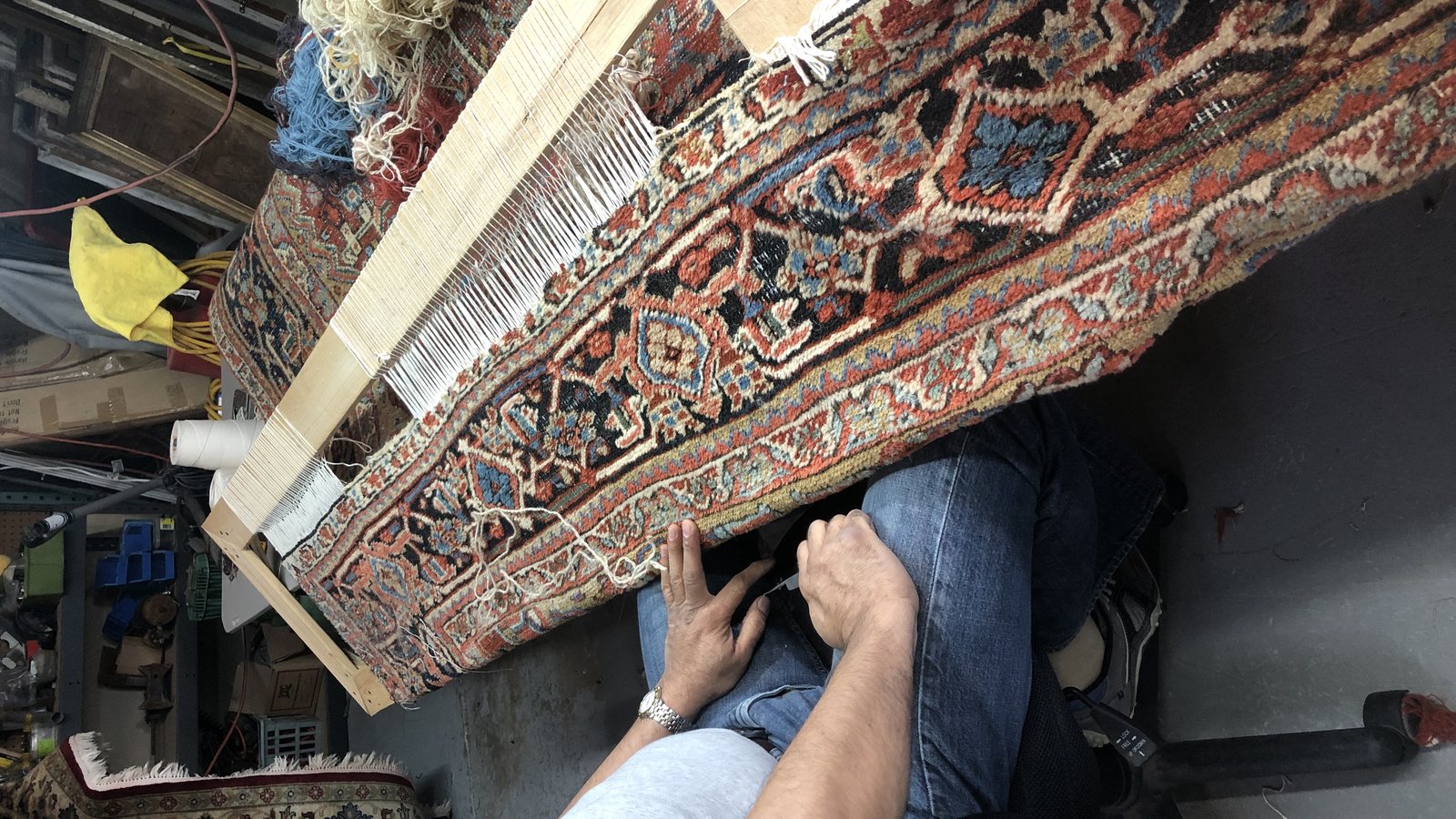
A rug's foundation follows that swing with a lag, and what fails is almost never the middle of the field. It is the edges and the ends, where cotton is doing the moving and the wool beside it is not.
Side cords go slack, fringe knots open, and any earlier repair shows itself first because it was matched to the rug at one point in that cycle rather than across all of it.
Where the house puts the rug
Sequoyah Hills and Old North Knoxville keep a lot of original wood floors, and an original board floor is a moisture path rather than a barrier.
Old boards shrink, gap and let air through from whatever is below them, so the rug over the top is in exchange with the underfloor space. That is fine for 227 days a year and not fine for the other 138.
Westmoreland bring solid masonry into it, and masonry holds cold long after the air in the room has warmed.
The coldest surface in a masonry-walled room is the floor along the exterior wall, which is exactly where a room-sized rug ends. It picks the moisture up in the foundation rather than the pile, where nobody is looking for it.
The oldest housing on the collection route goes back to the 1880s, and construction of that age was not built to keep ground moisture out of the rooms above it — which is worth remembering before blaming a rug's condition on the rug.
What that actually sends in for repair
Rugs that will not lie flat
A foundation that takes up moisture over 138 damp days and gives it back over 54 freezing nights of heated indoor air changes dimension twice a year, and wool and cotton do not change by the same amount.
The result is ripple, buckling and a rug that has quietly gone out of square; it is corrected by washing and blocking back under tension, not by moving the furniture.
Foundation loss, not surface wear
Cellulose held damp loses strength, and 19 unbroken days above 75% is long enough for it to matter.
A foundation going that way gives no cosmetic warning, so the test is mechanical: fold a corner and see whether it flexes or crackles, and pull gently on a fringe tassel to see whether it is still anchored in anything.
Fringe, because fringe is the foundation
Fringe is the warp ends of the rug, not a trim, so 138 days a year of damp working on cotton warps shows up there before it shows up anywhere else.
Once the ends let go the rug starts unravelling from the edge inward, which is why a fringe that has begun to shed is worth dealing with while it is still a fringe job.
Figures above are from the ERA5 reanalysis record for the five years from 2021 through 2025,
taken at the center of the East Tennessee service area. If what you are seeing on your rug
matches any of this, send photographs and we will tell you which of these it is.